
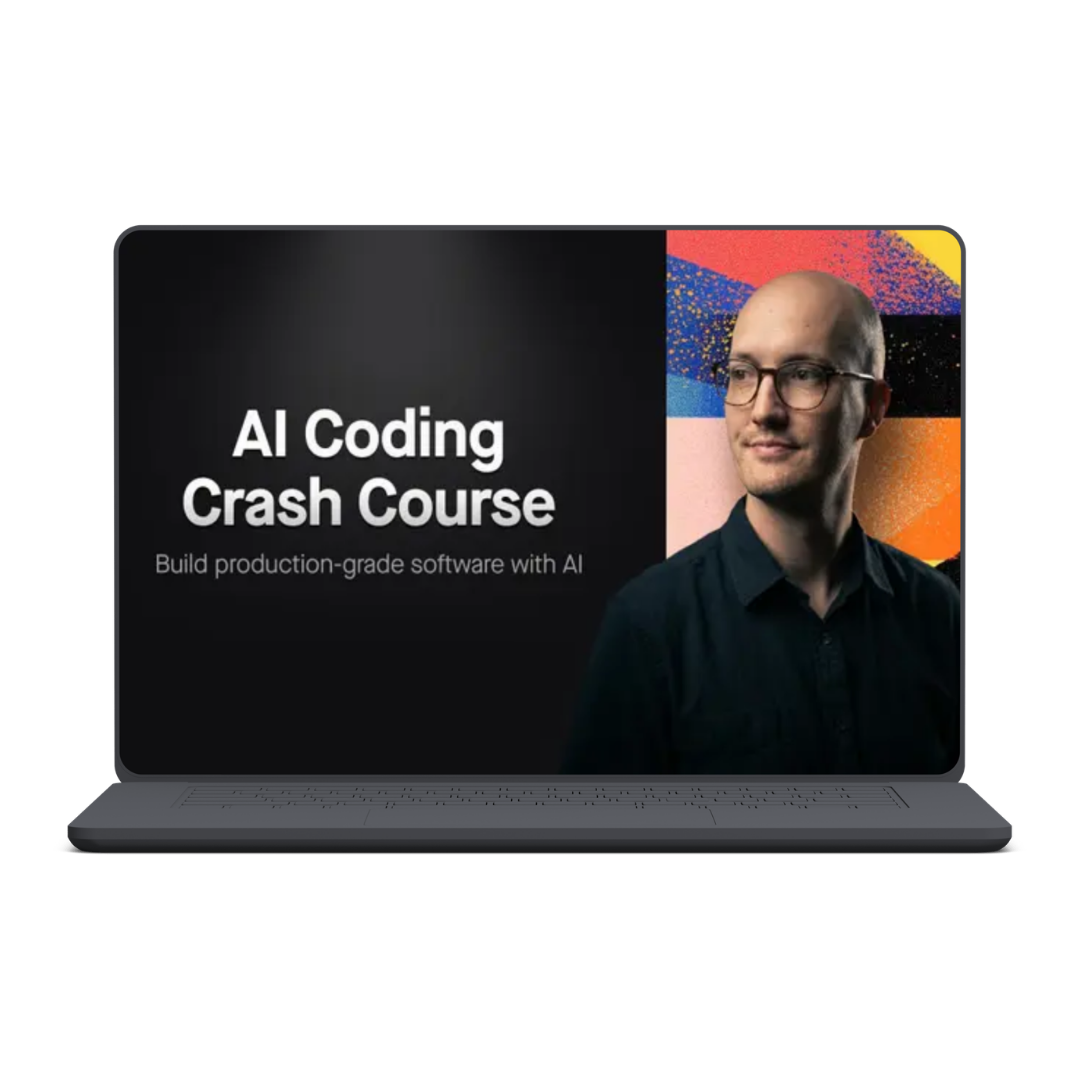
AI Coding Crash Course - A self-paced workshop from Matt Pocock

Learn to control Claude Code, Codex, and other coding agents through context management, clear specifications, skills, handoffs, and subagents.
Stop “Vibe Coding” and Start Engineering with AI
AI coding agents make starting a project feel effortless. But as the codebase grows, poorly defined requirements, weak architectural choices, and overloaded context can cause each new change to become slower and less reliable.
The agent continues producing code, while you spend more time reviewing mistakes, repeating instructions, and trying to understand what changed.
AI Coding Crash Course by Matt Pocock teaches a more controlled approach. Instead of relying on “say and pray” prompts, you’ll learn how language models, coding harnesses, context windows, and agent workflows operate—and how to combine them with dependable software-engineering principles.
The course uses Claude Code for practical demonstrations, but its core methods can also transfer to Codex and other capable coding agents.
What You’ll Learn
The course helps you create a repeatable AI-assisted engineering workflow for projects that are too complex for one prompt.
You’ll learn how to:
- Understand how large language models generate code
- Work effectively with an AI coding harness
- Recognize when an agent’s context has degraded
- Keep sessions within the productive “smart zone”
- Manage token and context usage more deliberately
- Choose between compaction, handoffs, and new sessions
- Turn unclear ideas into precise project requirements
- Help agents explore existing codebases correctly
- Use AGENTS.md to guide project-wide behavior
- Build reusable agent skills and instruction packages
- Apply progressive disclosure to keep context lean
- Divide complex projects into manageable phases
- Create reliable handoffs between sessions
- Delegate research and exploration to subagents
- Enforce stronger code-quality standards
- Ship features without losing control of the codebase
The focus is not simply generating more code. It is creating software you can understand, maintain, test, and extend.
The Complete 6-Section Curriculum
Section 1: Before We Start
Prepare your tools, environment, and expectations before beginning the practical work.
This section establishes the foundation required to follow the exercises and understand the AI coding workflow used throughout the course.
Section 2: Concepts
Learn how language models, context windows, and coding harnesses function.
You’ll explore the smart zone versus the dumb zone, what consumes context, why performance can decline during long sessions, and how to identify context problems before they damage the project.
Section 3: Getting to Know Claude Code
Become comfortable operating a command-line coding agent.
You’ll inspect how the harness works, understand what information it receives, and learn how to interact with it more deliberately instead of treating it like a mysterious black box.
Section 4: Fundamentals
Develop the core habits required for reliable AI-assisted engineering.
Topics include codebase exploration, requirements gathering, project instructions, AGENTS.md, reusable skills, progressive disclosure, and helping the agent work with existing architecture rather than duplicating it.
Section 5: Steering
Learn how to keep the agent focused throughout larger and more complicated tasks.
You’ll turn fuzzy ideas into clear specifications, divide work into session-sized phases, correct direction early, and provide the context required for each stage without overwhelming the model.
Section 6: Shipping
Apply the complete workflow by building real features from beginning to end.
This section covers handoffs, fresh sessions, subagents, code-quality enforcement, and the practical process of completing work that cannot fit inside one prompt or context window.
Key AI Coding Methods Covered
Grilling
Use the coding agent to interrogate an unclear idea before implementation begins.
This process helps uncover missing decisions, ambiguous requirements, edge cases, and assumptions before they turn into faulty code.
Context Management
Understand exactly what is filling the context window and how to keep it useful.
You’ll learn when to continue, compact, create a handoff, or begin a fresh session.
AGENTS.md and Skills
Create project-level instructions and reusable skill packages that guide agent behavior.
Instead of rewriting the same prompt, your coding agent can load the relevant standards and workflow when required.
Handoffs and Subagents
Leave clear progress records so a future session can continue without rebuilding the entire situation.
Subagents allow you to delegate focused exploration or research while protecting the context of the primary session.
What’s Included?
The original course provides:
- Nearly 60 self-paced lessons
- Six structured curriculum sections
- On-screen video instruction
- Detailed written lesson guides
- Commands and prompts to practice
- Knowledge-check quizzes
- Progress tracking
- English transcripts and subtitles
- Discord community access
- Completion certificate
- Lifetime access to the lessons
You can work through the training intensively over several days or spread it across your own schedule.
Who Is This Course For?
AI Coding Crash Course may suit:
- Developers using Claude Code or Codex
- Non-programmers beginning with coding agents
- Founders building AI-assisted products
- Engineers struggling with unreliable agent output
- Teams adopting agentic development workflows
- Developers managing large codebases with AI
- Technical professionals seeking cleaner processes
- Anyone wanting engineering discipline beyond vibe coding
See More: Gusten Sun - AI Academy , Solnest AI By Ryan Lefebvre (2026 September) , Build an AI agent platform with Claude Agents , Jay Margaliot – Build Your First AI Empoloyee in 5 Days
AI Coding Crash Course - A self-paced workshop from Matt Pocock
Name of course: AI Coding Crash Course - A self-paced workshop from Matt Pocock
Delivery Method: Instant Download (Mega)
Contact for more details: Digitalhub.courses@gmail.com